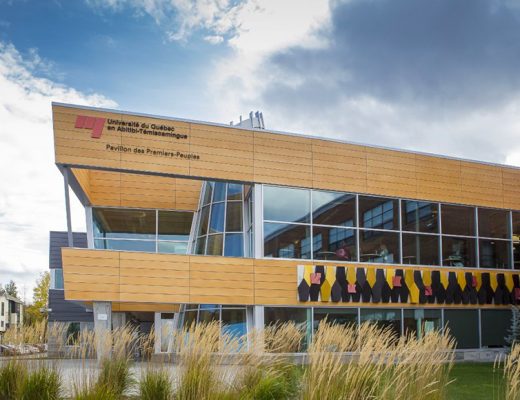
Historically, the connection First Peoples have to education in general and postsecondary education in particular is characterized by assimilation.1 Committing to higher education has long meant adapting to the values and cultural behaviors of the postsecondary institution attended (Gallop and Bastien, 2016). Pursuing postsecondary education was a type of “compulsory enfranchisement”2 that resulted in loss of status.
Research has identified expressions like “culture shock” and “cultural discontinuity” being used to describe the discomfort and difficulties students experience. As part of the reconciliation process, the cultural safety approach aims to lessen the detrimental effects by creating relationships of trust with First Peoples and making environments more welcoming and secure. This is an essential step to counter the cultural assimilation of First Peoples attending higher education institutions and to promote access, perseverance, and success.
A responsibility rather than an adaptation
The concept of cultural safety originated in the late 1980s in New Zealand, in response to the marginalization and discrimination Maoris experienced in the non-Aboriginal healthcare system (Ramsden, cited by Dufour, 2016). In Canada, the concept of cultural safety has also been used in the healthcare field (Baba, 2013).
Underlying this approach, which is central to the relationship between First Peoples and non-Aboriginal people, are:
- consideration of the effects of colonization and the resulting trauma
- recognition of and respect for cultural and social differences
- an understanding of the issues First Peoples face today, whether they live in a remote community or an urban area
- a willingness to join forces with First Peoples in the development, delivery, and assessment of services or initiatives offered to them
- a commitment to adopt practices and service deployment models that take the values, cultures, and realities of First Peoples into account
- a collective or institutional willingness to change our perspective and our processes, to foster social justice and innovation.
A cultural safety approach is thus not limited to measures or processes for adapting education, services, or support for First Peoples students.
Rather, it is a shared responsibility that unites all members of postsecondary institutions in a process of individual and collective awareness, learning and transformation, in partnership with Aboriginal authorities and communities.
This process of raising awareness among non-Aboriginal people (the student community and teaching and support staff) of First People’s cultural reality aims to highlight Aboriginal differences, contributions, and knowledge, and to recognize their history and rights.
A cultural safety approach is based on the principle of social justice and is part of a dynamic of affirmation, transformation, and reconciliation (Lévesque, 2017). It seeks meaningful social transformation by reviewing public policies targeting First Peoples and updating practices to foster decolonization and self-determination (Val‑d’Or Native Friendship Centre, 2017). For Lévesque (2017), cultural safety is a tool for social justice, a vehicle for reconciliation, a driver of social change, and an opportunity for social innovation.
Steps towards cultural safety
Certain steps need to be taken in order to build a culturally safe environment that allows individuals and communities to reach their full potential. During this process, reflexivity starts at the individual level and then advances to the collective level, switching from I to we, as illustrated in the following table.

Dedicated spaces
Research by Dufour (2016) suggests that providing culturally safe educational spaces within institutions promotes postsecondary retention and success among First Nations students in Quebec.
Creating spaces for social and cultural gatherings is a first step in this direction.
Learning content
One way to promote cultural safety is to study the history, cultures, and policies that have characterized the socio-economic evolution of First Peoples. Students are then able to better contextualize and address the issues facing their family and community (ibid.). In terms of cultural safety and continuity, Kiuna College, founded in 2011, is squarely in line with its predecessor, Manitou College in La Macaza (1973-1976) and with the Tribal Colleges and Universities (TCU) in the United States (Dufour, 2015). Kiuna’s academic approach is based on adapting college programs focused on achieving universal skills and provincial educational benchmarks, while strongly emphasizing cultural reinforcement.
Kiuna’s educational initiative thus turns a “tool of assimilation into an instrument of empowerment” (Stonechild, cited by Dufour, 2015).
Cultural activities
Another way to implement a cultural safety approach is to organize educational activities and field trips that give students access to the Aboriginal heritage, languages, and cultural practices some of them were deprived of due to the colonial context (Dufour, 2016).

These examples show the importance of promoting and funding structural changes that provide cultural safety for First Peoples students in all Quebec colleges and universities.
Safe attachment to culture and community can in turn serve as a launching pad for various levels of individual and collective success (Dufour, 2016).
1 Education involved assimilation as a matter of course. At the primary and secondary levels (in residential schools), attending school was already an assimilation process that followed a continuous path from one type of instruction to another.
2 The Canadian Indian Act sought to “enfranchise” Indians, as specified in Section 109. This meant they would no longer legally be Indians and would have all the attributes of citizenship. An amendment introduced in 1880 meant that anyone who earned a university diploma was automatically stripped of their Indian status. Provisions addressing enfranchisement would not be repealed until 1985 (https://www.thecanadianencyclopedia.ca/en/article/indian-act).
Related Articles